
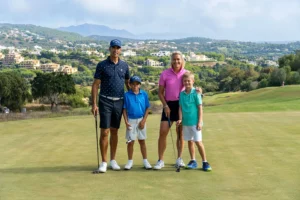


Euphemie ‘Mimi’ Rhodes (born 17 December 2001) is a dynamic young professional golfer who was born in Bath, England, and raised in Sotogrande. A standout amateur player, she turned professional in 2024 and quickly made her mark on the 2025 Ladies European Tour by finishing second. Mimi began her 2026 season on the Ladies Professional Golf Association Tour, recording a commendable 10th-place finish in the year’s first event in Singapore.
She now represents the Alto Club as its official touring professional ambassador.
Suzann Pettersen is one of the most respected figures in golf. Born on 7 April 1981, she is a former professional golfer from Norway, a two-time major champion and former Solheim Cup captain. She is now a Global Ambassador for the Alto Club Golf Academy in Sotogrande.
Suzann Pettersen in conversation with Mimi Rhodes
It’s a privilege for me to serve as Global Ambassador for The Alto Club Golf Academy in Sotogrande. I am delighted to learn that you grew up in Sotogrande and are sponsored by The Alto Club.
I heard that your grandmother introduced you to golf at the age of eight. Can you tell me a bit about how that happened, where it was, and what you thought at the time?
My late grandmother was a very good golfer with a single handicap. She was a member of Burnham & Berrow Golf Club near Weston-super-Mare. After school, my sister and I would often visit her and she would take us out onto the course. It was great fun. We would play a few holes, have little picnics, and enjoy spending time together outside.
She introduced me to the joyful side of golf. My sister and I brought our love of the game with us when we moved to Spain. Whenever I went back to England to visit my grandmother, we would spend quality time together on the golf course. Sharing our love of golf is one of my fondest memories; she was and still is my golfing inspiration.

Sotogrande has several iconic courses, such as Real Club Valderrama, Real Club de Golf Sotogrande, and La Reserva Club. Which course taught you the most about your game, and why?
The course that taught me the most about my game is La Cañada, a smaller course where I first started playing. The other courses — La Reserva, Valderrama and Real Club de Sotogrande — are incredible, and I was fortunate enough to practise on them occasionally. Since turning professional, the staff have been very supportive and welcoming, allowing me to practise and play.
However, it was at La Cañada that I truly developed my game. I practised there constantly and attended many group lessons with players my own age. Playing with the boys in those early years helped me enormously and pushed me to improve. It was a fantastic environment in which to grow up as a young golfer.
Can you describe your experience of growing up in Sotogrande as a young golfer? And how that may have defined your future in the game?
Growing up in Sotogrande was incredible. From the age of seven, I was surrounded by five or six golf courses, all of which were within a five-minute drive. I think I was destined to play golf — no other sport has ever held my attention in quite the same way.
There were excellent programmes to help young boys and girls get into the sport, and everything was so accessible. Having the beach nearby meant that other activities were also available, but for me, it was always about practising at the golf course. The fantastic weather made such a difference. It really was the perfect environment in which to develop as a golfer.
The Alto Club Golf Academy blends a luxury lifestyle with elite training. What part of the new academy are you most excited about using between tournaments?
The Alto Club combines world-class training facilities and advanced technology. The parts I am most excited about are the par three course and the wedge area. As a professional golfer, it is essential to be precise with your wedges, your putting and your short game. These are crucial because that is where you create birdie opportunities or let them slip away. This is what makes or breaks your game.
I’m excited to use the facilities and spend most of my time there.

What is the biggest advantage for you when using advanced ball-tracking technology?
The biggest advantage is understanding the numbers behind each shot. This enables me to approach every ball as if I were on the course. When pitching, for instance, I pay close attention to launch angle, spin rate and distance control.
I use ball tracking technology in every practice session. It is hugely beneficial that The Alto Club provides this, as it means I can measure my improvement in distance and ball control after every session. This is equally helpful for amateurs, who often find club speed and distance fascinating. This technology supports both elite players and beginners.
What is most important for you when you practice?
That’s a good question, because as a professional golfer, you need to work on all areas of your game, but time is limited. After a tournament, I like to review my statistics and identify where I struggled.
The short game is particularly important: practising different lines, chip shots, and high flop shots; and using different clubs around the greens. Once you are confident around the greens, you can play more aggressively, knowing that even if you miss, you can still chip up and down either way.
I spend a great deal of time putting every day. I always start on the putting green because ultimately, it’s holing putts that will help you in a tournament.
How important has your support network — family, coaches, and friends — been as you transitioned from amateur success to professional wins?
My support network has been invaluable.
My parents have always supported my goals, whether it’s driving me to tournaments or investing their time and money in my career. I work hard partly to repay them for all they have done.
I have also been fortunate to have had excellent coaches throughout my career. I am still working with the same coach I started with when I was thirteen; he has guided me every step of the way. Knowing that the people around you are proud of you, whether you win a tournament or miss the cut, takes away a lot of the pressure. It allows you to compete knowing that, ultimately, you’re just out there doing it for yourself.
When playing golf, crowds can be both encouraging and unforgiving. How do you block out the noise and stay focused on your game?
Playing in front of crowds in competitions can have both positive and negative aspects. It can be motivating and challenging. It’s easy to get caught up in wanting to perform well for the spectators.
So, it’s important to stay focused on your process, shot by shot. I focus on my breathing, maintain the same walking pace, and stay engaged with my caddie. When I have tried too hard to impress the crowd, it has backfired. The key is to appreciate their presence without forcing anything, and to simply concentrate on the task at hand.

Social media gives female athletes visibility but also scrutiny. How do you protect your sense of self while still inspiring and connecting with others?
Although social media can be challenging, it is also an important platform. It enables you to connect with younger audiences and encourage more girls to take up the sport. I focus on positivity and try to ignore negative comments.
Social media is also an important tool for building your brand, particularly as sponsors pay attention to your online presence. I try to use social media constructively while setting boundaries. When I’m practising, I put my phone away and focus fully on my work. The key is to use social media to your advantage while protecting your own wellbeing.
In golf, you kind of have to use it to grow your following and inspire the next generation.
Golf still faces inequality between male and female players in terms of opportunities, earnings, and exposure. Have you experienced this, and how do you navigate these challenges?
Inequality between men’s and women’s sports still exists, and golf is no exception. The prize funds were lower than I had expected, although they have improved significantly in recent years.
When I first started, there was hardly any money in women’s golf; at one point, I even considered changing my career path.
With bigger events and Saudi Arabia’s involvement in golf, prize funds have really increased. I am excited to be on the LPGA (Ladies Professional Golf Association) tour, there are more earning opportunities.
I have encountered assumptions throughout my career, such as people assuming that it was my father or grandfather who introduced me to the game, when it was actually my dear grandmother. However, these attitudes are becoming less common. Women’s golf is trending in the right direction, and I believe that, in five or ten years’ time, it will be in a very strong position.
At The Alto Club Golf Academy, the focus is both on excellence and enjoying the game. How do you balance competitive ambition with the joy of playing golf?
I balance competitive golf by enjoying it. I have always enjoyed practising and spending four or five hours at the course, so it has never felt like hard work.
Having The Alto Club so close to home makes maintaining this balance even easier. I can practise for a few hours, make use of the full range of facilities and train in the gym, while still spending time with my family.
That balance is important, being able to go home to a family meal cooked by my mum after training helps to keep things in perspective. I believe that enjoying the process allows you to pursue excellence without losing perspective.

Many young golfers look up to you. What one piece of advice would you give to someone just starting out, especially girls who want to compete at the highest level?
My advice would be to make the most of the facilities around you and practise with others. Bring a friend or sibling or find someone at a similar level. Starting alone can be daunting, which may cause you to lose interest.
Most importantly, don’t take it too seriously at first. Enjoy the game and let your competitive side develop naturally. If you love what you’re doing, the progress will follow.
Curiously, in both of our careers, during our inaugural seasons on the Ladies European Tour, we both finished runner-up in the Order of Merit and won Rookie of the Year — mine in 2001 and yours in 2025. What goals are you setting for yourself in 2026 — both in golf and in life?
That’s a really interesting fact! I hadn’t realised that. It’s a fascinating coincidence, especially since I was born in 2001 — that’s really cool!
I have always looked up to you, particularly after watching you play in the Solheim Cup at Gleneagles in 2019, when you made that decisive putt to win the Cup. It’s a great honour to share that parallel in our careers. You’ve been a huge role model.
Looking ahead, my main goal in golf is to enjoy my first season on the LPGA Tour and focus on improving rather than on results. I will be competing against the best players in the world, so there will be new challenges and pressure. Of course, I want to play well and win, but my priority is to keep progressing with each tournament.
In life, I want to maintain balance. I sometimes overwork and become too focused on golf, so I need to make sure that I spend quality time with my family and friends, travel to new places and maintain a sense of perspective. If things don’t go my way on the course, I want to handle that maturely and continue enjoying the journey.
One of my biggest ambitions is to make the Solheim Cup team. If I achieve that, it would mean everything to me. If not, I will work even harder for the next opportunity.